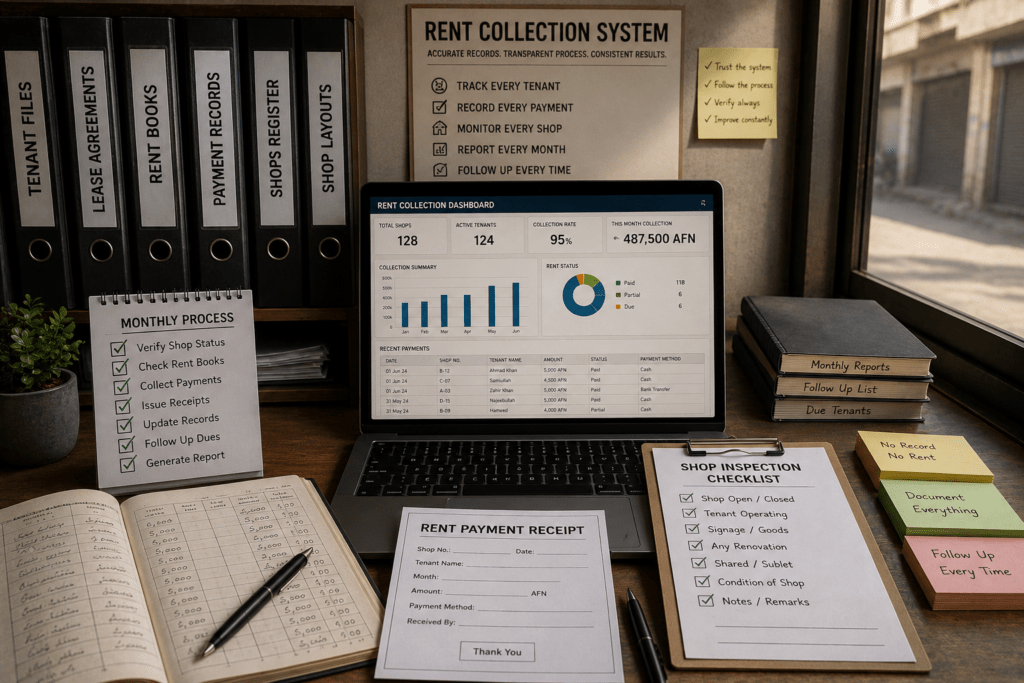
For three years, a shop in my own commercial complex didn’t exist on paper. It had a tenant. Had goods moving in and out of it. It had a door that opened and closed like every other shop on the row. But on my reports, it was empty. Closed. Not generating rent, not costing me anything — at least that’s what I believed. It wasn’t empty. A man was using it as storage, paying my rent collector 2,000 Afghanis a month in cash. The real rent for that shop was 5,000. The collector kept the difference, never wrote it down, and told me the shop was closed whenever I asked. I found out by accident, roughly three years later.
That shop is one of three stories in this case study. None of them involve theft you’d report to police, or a confrontation, or anything that would make a good headline. What happened was simpler and harder to catch: without a system in place, ordinary dishonesty went undetected for years. This is the story of what that cost me, and the commercial real estate rent collection system I eventually built. I built the system first by hand, then by running it myself, month after month, until I trusted it — to make sure it couldn’t happen again.
The Business Behind the Story
I manage a family-owned commercial real estate portfolio in Paktia, Afghanistan. Few large complexes of retail shops rented to local business owners. It’s the longest-running business in my family, and one I run as general manager: leasing, collections, tenant relationships, expansion, and the systems that hold all of it together.
What you’re about to read is the story of the commercial real estate rent collection system I built to close that gap. I made three discoveries that forced me to build this system. I won’t share the exact number of shops in the complex. What matters for this story isn’t the size of the portfolio — it’s what happens to any portfolio, regardless of size. When the person responsible for it isn’t physically present and the operation runs on memory and trust instead of records. For years, that’s exactly how it ran.
Three Things That Were Happening Without My Knowledge
Before I get to the moment that changed how I ran this business, I want to walk through what was actually happening on the ground. The scale of what I didn’t know is the entire reason to build the system.
Suppose you are a property owner and your tenants sue you for breaking the law unknowingly… This compensation amount in some cases can cost you your whole property. In my business the main paved ground for disputes to arise was not having legal documents or contracts between the owner and the tenant. Before this system we used to give the tenants a verbal notice for rent payment or vacating the property. The most common issue that could drown me in compensations and disputes was not having written agreements. The landlord/tenant relationship was nonexistent. Just from the angle of legal literacy rather than operational systems, I’ve written before about why verbal agreements fail.
Case One: The Tenant Who Wasn’t in Any Report
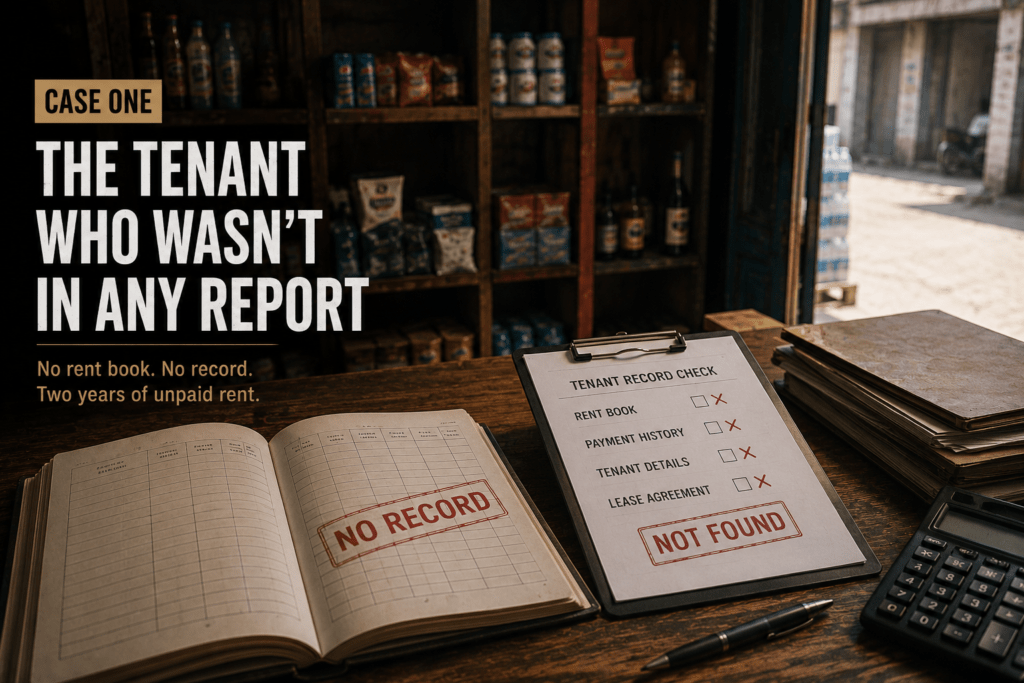
This is the case I’ve mentioned before in other parts of my business documentation. This case was the first real signal that something was structurally wrong.
A tenant stopped paying rent. Not partially — completely. For two years.
He didn’t appear delinquent in any report I received, because he wasn’t appearing in the reports at all. He had no rent book of his own. No record existed anywhere in my system showing he had a shop, let alone that he owed two years of unpaid rent.
I found this only because I decided to physically visit the property and go shop by shop. During a period of disputes at an annual review, I went to check every single rent book myself. When I reached his shop, there was nothing to check. No book. No history. I genuinely thought, for a moment, that the shop wasn’t part of my own complex.
When I asked him directly, he insisted he had been paying and everything was in order. I had no way to verify either version of events, because there was nothing on paper.
The lesson: A tenant who never appears in a report isn’t a tenant who’s compliant. He might be a tenant nobody is tracking at all.
Case Two: The Shop That Was “Closed”
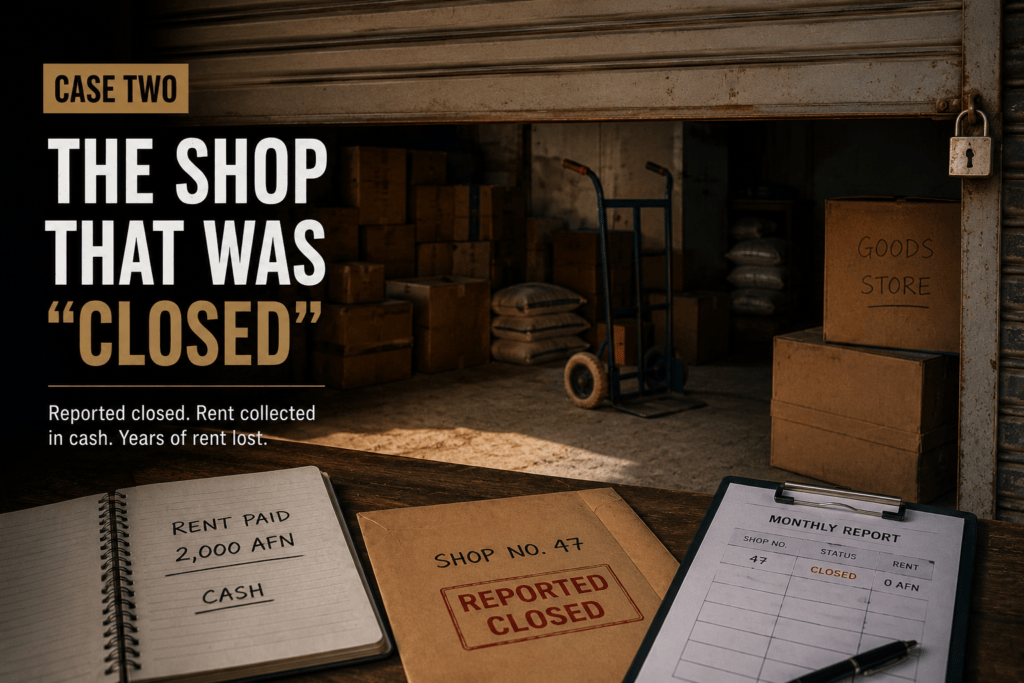
This is the godown story I opened with.
My rent collector told me a particular shop had been closed for a long time. If a shop is closed, there’s no rent to collect, so I simply removed it from the active rent list. No tenant, no rent expectation, no further attention.
What was actually happening: a man was using the space as storage for his goods, walking in and out regularly. He was paying the collector 2,000 Afghanis a month directly — about 40% of the real 5,000 Afghani rent. The collector pocketed it and reported the unit as vacant.
I only discovered this after speaking with neighboring shopkeepers, who confirmed the unit had been actively used the entire time. When I confronted the tenant directly with the real number — 5,000 Afghanis, not 2,000 — there was no paperwork on either side to dispute it. The arrangement had existed for years, entirely off any book I owned.
The lesson: “Closed” is not a fact. It’s a claim. And a claim with no documentation behind it can quietly cost you years of rent.
Case Three: Shops That Changed Shape Without My Knowledge
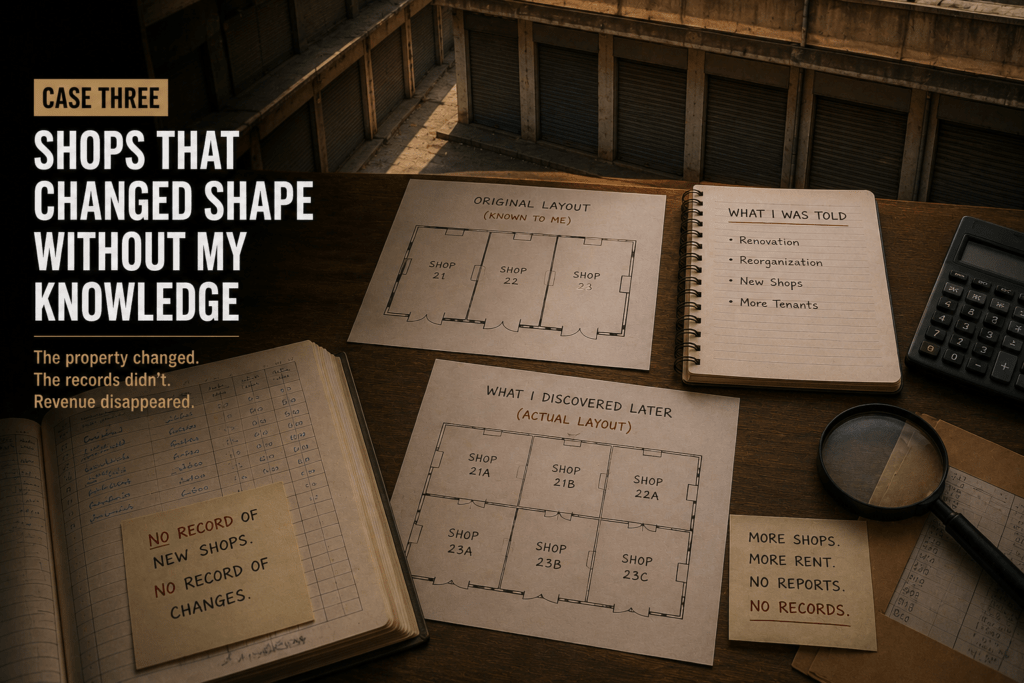
The third pattern was less about individual fraud and more about how easily physical reality drifted away from what I believed was true on paper.
Shops were renovated, removed, merged, or split. Sometimes three large units became six smaller ones — and none of it made its way back to me in a form I could track. I wasn’t told. There was no shop-level record that could have flagged the change. The property was changing shape and my records simply hadn’t caught up, because there was no structure requiring them to.
The lesson: Without a fixed unit of record — something as simple as a permanent shop number — the physical business and the paperwork describing it can drift apart indefinitely, and no one will notice until someone forces a reconciliation.
The Real Cost of Not Knowing
None of these failures, on their own, looked catastrophic in the moment. A missing tenant here, a “closed” shop there. But none of them were isolated, either — they were all happening at the same time, in different shops, for years, without anything connecting them until I went and checked every book myself.
Across roughly four years where I was rarely able to visit the property in person, the business lost approximately 5 million Afghanis. As more of these gaps surfaced, the total climbed to around 8.6 million Afghanis. Just for context a normal family of 5 can have a comfortable life with around 30,000 – 40,000 Afghanis/month.
I want to be precise about what that number represents, because it’s not theft in the dramatic sense. It’s the sum of every shop that wasn’t being tracked properly. Every “closed” unit that wasn’t closed, every dispute that had no paper trail to resolve it, and every report I received that I had no way to verify against reality.
That gap between what I believed was happening and what was actually happening cost more than any single mistake I can point to in this business.
The Turning Point
The shops are in Paktia. I was living in Kabul — about five hours away by road. For most of the year, I managed the business remotely, visiting once or twice a year at most. During one stretch, four full years passed where I wasn’t able to visit at all.
That distance is where all three of the stories above were able to exist undetected for a long time. Not because the people involved were uniquely dishonest, but because nothing about the operation required honesty to be checked. Reports came in over WhatsApp. I trusted them because I had no real alternative — I wasn’t there to compare them to anything.
The turning point wasn’t any single discovery. It was the realization, after adding up what those years of distance had actually cost. The problem wasn’t the tenants, and it wasn’t even fully the rent collector. The problem was that I had built a business that depended entirely on my physical presence to function honestly. The moment I stepped away, the business had no way to police itself.
I decided the commercial real estate rent collection system had to work whether I was standing in front of it or five hours away in Kabul — or, eventually, in another country entirely.
So I built one. And then I went back, month after month, to run it myself until I was sure it actually worked.
Building the commercial real estate rent collection System: Proving It Myself Before Handing It Off
This wasn’t a system I designed at a desk and handed off untested. Starting in 2021, alongside my brother, I went back to the property every month and collected the rent myself, using the new commercial real estate rent collection system, before I trusted anyone else to run it. I wasn’t willing to put a collector in charge of something I hadn’t already proven worked.
Step One: Agreements First
The very first thing I did — before any books, before any numbering system — was put a written agreement in place between the owner and every shopkeeper. This single step did more to change behavior than anything that came after it.
I expected resistance. I didn’t get much. Most shopkeepers welcomed it, because they had been exposed to the same lack of documentation I had. A shopkeeper would pay the collector rent one month, and the following month the collector would claim two months were owed, with no proof on either side of what had actually been paid. Written agreements protected tenants as much as they protected me.
Step Two: Permanent Shop Numbers
Every shop in the complex was assigned a permanent number. This was independent of who was renting it or what state the physical unit was in.
This solved Case Three directly. If a tenant changes, the shop number doesn’t change — only the name attached to it does. If a shop is physically split or merged, the number and the record can be updated deliberately, rather than silently disappearing from tracking. The shop became the fixed unit of truth, not a verbal description of “the shop near the corner.”
Step Three: The Dual-Book Method
Every shop has its own book, kept by the shopkeeper. The rent collector records the month, the amount collected, exchange rate alongside his name and sign. The shopkeeper would also sign his own book to confirm he paid the rent to the collector.

The collector separately keeps his own book — a simpler version with the shop number, shopkeeper name, amount, and his signature. He would record every collection across every shop he handles in his own book.

The two books exist precisely so they can be compared. The shopkeeper has proof of what he paid. I have an independent record of what the collector says he collected. Where the two don’t match, someone has to explain why.
Step Four: Monthly Reporting, Quarterly Verification
At the end of each monthly collection cycle, the collector compiles a report. The report would include any related expenses and sends it to me over WhatsApp. I manually enter that information into a digital system on my computer.
Every three months, I go further: I visit in person and photograph every shopkeeper’s book, then compare those photos directly against the monthly reports I was sent. Any shortfall between what the shopkeeper’s book shows and what the collector reported becomes the collector’s responsibility to explain.
This quarterly audit is the step that actually catches what monthly reporting alone would miss. A monthly report only tells you what the collector wants you to know. A side-by-side comparison with the shopkeeper’s own book tells you what’s true.
Step Five: Teaching Tenants to Protect Themselves
Once the agreements, books, and numbering were in place, I ran informal sessions with shopkeepers explaining how the system worked — specifically, how to recognize and protect themselves against a dishonest collector, and what would happen if a collector was caught committing fraud (immediate removal).
This mattered because the tenants had been just as exposed to the old system’s failures as I had. Making them active participants in their own protection turned them into a second layer of oversight I didn’t have to manage myself.
The full transition — agreements, books, numbering, and the first round of education — took about a month, though most of the groundwork moved quickly once I started: roughly ten days once I began actually issuing agreements and new books.
How the commercial real estate rent collection System Runs Today
The system is still, deliberately, a manual one. Given the level of technology familiarity on the ground, I haven’t introduced automated reminders or digital collection — and I’d rather have a manual system that’s actually used correctly than an automated one that creates new gaps because no one trusts or understands it.
Here’s the cycle as it runs now:
- Reminder window. Starting on the 25th of each month, the rent collector visits every shop in person to remind tenants that rent is due, with payment expected by the 30th.
- Collection and dual signing. When rent is collected, the collector records the amount, date, and any notes directly in the shopkeeper’s book and signs it. He then logs the same collection — shop number, shopkeeper name, amount, his signature — in his own book.
- Monthly report. At the end of the collection cycle, the collector compiles a report, including any expenses, and sends it to me over WhatsApp.
- Manual entry. I add everything from that report into my own digital system.
- Quarterly audit. Every three months, I visit and photograph every shopkeeper’s book, comparing it directly against the reports I was given. Discrepancies are the collector’s responsibility to explain.
- Escalation when rent isn’t paid. If a tenant can’t pay in a given month, he’s typically given the option to pay double the following month. If he’s unwilling or unable to do that, the next step is an informal notice that the unpaid amount will be deducted from his original advance payment. If the advance is exhausted and rent is still unpaid, a formal notice to vacate is issued at the end of that month, in line with the lease agreement. During that final month, I’m already looking for a new tenant, and the outgoing shopkeeper is looking for a new shop.
Every part of this system exists because one of the three failure cases exposed exactly the gap it now closes.
What the System Actually Found and Recovered
I want to be careful here, because exact figures tied to portfolio size aren’t something I’m willing to share publicly. But the directional numbers are real, and they’re the clearest evidence that the system did what it was built to do.
Once the dual-book method and quarterly audits were fully in place, we identified that roughly 12% of yearly incomehad previously been lost annually to a combination of fraud, unrecorded transactions, and simple operational waste — money that existed, should have reached me, and didn’t.
Since the system has been running, we’ve recovered approximately 15% of yearly income that would previously have been lost to exactly these kinds of gaps. Part of that recovery comes from catching new attempts at misreporting before they compound for years the way Case Two did. Part of it comes from a cultural shift: a collector who knows his book will be checked against the shopkeeper’s book every quarter behaves differently than one who knows no one is comparing anything.
The system also changed something less measurable but, in practice, just as important: we stopped quietly writing off lost income as an unavoidable cost of doing business. Money that used to be absorbed as “normal loss” is now investigated, because there’s finally a paper trail to investigate it with.
Why This Kept Happening: People, Not the System
When I look back at all three cases, the failures weren’t failures of system design in the way people usually mean that phrase. They were failures of no system at all — and the absence of structure created room for ordinary human behavior to go unchecked.
In this business, most problems trace back to people, not process. Once the structural gaps were closed — the books, the numbering, the agreements — the recurring issue stopped being “the system doesn’t work” and became “how do I manage the people operating inside it.” That’s a different, and in some ways more permanent, kind of problem. Systems can be designed once and refined. People require ongoing oversight regardless of how good the commercial real estate rent collection system is.
Of the three types of failure I encountered — missing data, delayed data, and false data — false data was always the most damaging. Missing data tells you something is wrong; false data convinces you everything is fine when it isn’t. A collector reporting a shop as “closed” isn’t an absence of information. It’s a deliberate, confident piece of misinformation that actively redirects your attention away from the problem. That’s what made Case Two take three years to surface — not the absence of a report, but the presence of a false one.
In nearly every one of these situations, the failure wasn’t an honest mistake. It was intentional manipulation, made possible by the fact that no one was checking.
How I Decide What to Act On
When intelligence about a potential problem reaches me, I don’t act on the first version of the story. I look at it from multiple angles before deciding it’s real. But once I’m certain, I act immediately — I don’t delay a confirmed problem out of caution.
In this business specifically, severity is measured in one way: how much money the issue is costing. Whatever is eating the largest amount of money becomes the most severe problem, regardless of how it presents emotionally or how recently it surfaced.
Between speed and accuracy, I prioritize accuracy. Acting quickly on a wrong read of the situation tends to create more problems than it solves — a hasty accusation against an honest collector, or a wrong assumption about a shopkeeper, can damage a relationship that was never actually the source of the issue. Better to be certain and act decisively than fast and wrong.
One Pattern Across All My Businesses
This wasn’t the only business where hiring people I had a personal connection to created exposure rather than protection — I’ve run into a similar pattern in other ventures, including with people I’ve hired as relatives. Across every business I’ve run, the same hierarchy has held: control comes first, accountability second, and systems exist to enforce both.
What This commercial real estate rent collection System Actually Protects
Today, every shop in that complex has a number. Every shop has a book. If a shopkeeper leaves, the shop doesn’t disappear from the record — only the name attached to it changes. The account, the rent history, and the agreement are all still there, attached to the unit, regardless of who’s standing inside it.
That’s the real difference between how this business ran before the system existed and how it runs now. It’s not that fraud became impossible — no system makes dishonesty impossible. It’s that dishonesty now has to survive a written agreement, a permanent shop number, a second independent book, a monthly report, and a quarterly photo audit before it can go unnoticed for years the way it once did.
I didn’t build this system because I distrusted everyone working for me. I built it because trust, on its own, was never something I could verify from five hours away. A business that only stays honest when the owner is standing in front of it isn’t really under the owner’s control — it just hasn’t been tested yet.
Forward-looking vision
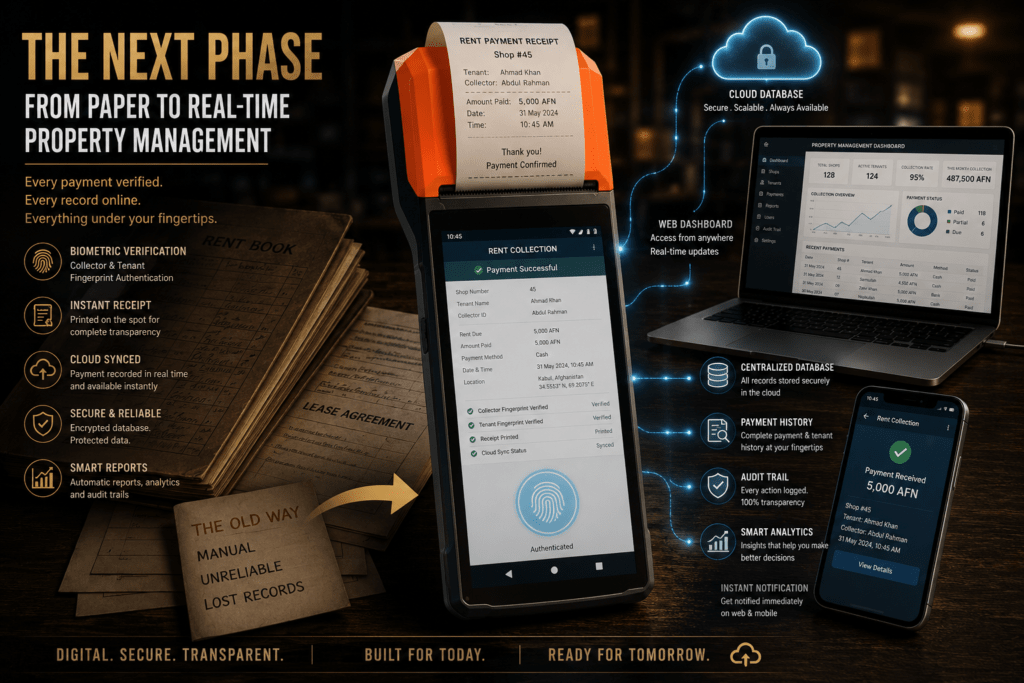
The commercial real estate rent collection system described in this case study is intentionally manual because it fits the realities of the environment it operates in today. But I don’t see it as the final version. The next phase is to digitize the entire process around a portable, cloud-connected handheld device carried by the rent collector. Before collecting rent, the collector would authenticate himself with a fingerprint. The tenant would then pay the rent, confirm the transaction with their own fingerprint, and receive a printed receipt directly from the device. At that moment, the payment would be synchronized to a secure online database, allowing me to see the transaction instantly from anywhere in the world through a web or mobile application.
Reports, payment histories, tenant records, shop information, and audits would all be generated automatically in real time. My goal isn’t simply to replace paper with technology—it’s to build a system where every payment is verified, every record is immediately available, and distance is no longer a weakness in managing commercial real estate.
Why didn’t you just fire the rent collector once you found the fraud?
The collector responsible for the specific cases in this story was dealt with directly once the facts were confirmed — but the deeper problem wasn’t one dishonest person. It was that the role of “rent collector” had no oversight built into it at all, for anyone who held it. Replacing one person without changing the structure would have just reset the clock on the same risk.
Why use physical books instead of a digital app or accounting software?
Because the system has to work for the people actually using it. Given the level of technology familiarity on the ground, a digital tool that tenants and collectors don’t fully trust or understand creates new gaps rather than closing them. The physical dual-book method is deliberately simple — and simple is what made it enforceable.
How do you know the collector isn’t just falsifying both books now?
The quarterly audit is built specifically around this risk. Because the shopkeeper keeps their own book — independent of the collector’s — and I compare the two in person every three months, a collector would need a tenant willing to lie on their own copy as well. That’s a much harder thing to coordinate than a single set of fabricated numbers.
What happens if a tenant disputes the amount in their own book?
The shopkeeper’s book is signed by the collector at the time of each payment, so it functions as the tenant’s own proof of what they paid. Any dispute gets resolved against that signed record rather than against memory or a verbal claim — which is exactly the gap that allowed Case One to go undetected for two years.
Could this system work for a portfolio with far fewer or far more shops?
The mechanics — permanent unit numbers, dual independent records, and a recurring audit that compares them — don’t depend on scale. What changes with size is how often the audit needs to happen and who carries it out. The core principle stays the same regardless of how many units are involved.
Did the shopkeepers resist the new agreements and record-keeping?
Not in any meaningful way. Most shopkeepers had been exposed to the same lack of documentation that hurt me — a collector could claim two months were owed with no way for the tenant to prove otherwise. The new system protected them as much as it protected me, which is part of why it was adopted quickly.
Let’s Talk
Was this article helpful?
Do you need this system designed for your own business?
Let me know in the comments
If this kind of operational case study is useful, here’s another one. How I managed unsold inventory on a running profitable business and doubled the sales.
Join OneMinuteSundays
Subscribe for short weekly emails on habits, productivity, and living a happier life while doing more of the fun stuff, and some content that I believe will be of good value to you.